Perspectives on Culture, Leadership, and Experience
Original thought leadership, articles, and content from Stephen Starks—
for leaders who are serious about building organizations that last.
Browse by Topic
🏛️
Culture & Leadership
2 Articles — March & May 2026
✨
Customer Experience
2 Articles — April & August 2026
🤖
AI & the Future of Work
2 Articles — April & June 2026
📈
Organizational Performance
2 Articles — April & June 2026
Latest Insights
“The loud customer is a gift. The quiet one is a warning you are about to miss.”
Customer ExperienceAugust 20264 min read
Silence Is Not Satisfaction
The customer who complains is doing you a favor. The one who says nothing and stops spending is the one who should worry you. There are more of the second kind every year.
The customer who complains is not your biggest problem. The one who says nothing is.
I learned that on a collections floor, long before anyone handed me a survey framework. At Ford Credit, the account that went quiet was never the good news it looked like. Silence did not mean the problem was solved. It meant the customer had stopped talking to us and started making other plans. By the time the numbers confirmed it, the decision was already made. I spent the next three decades watching the same pattern in better dressed rooms. The loud customer is a gift. The quiet one is a warning you are about to miss.
I do not need a report to know that. The report is worth reading anyway, because it says the warning is getting harder to hear.
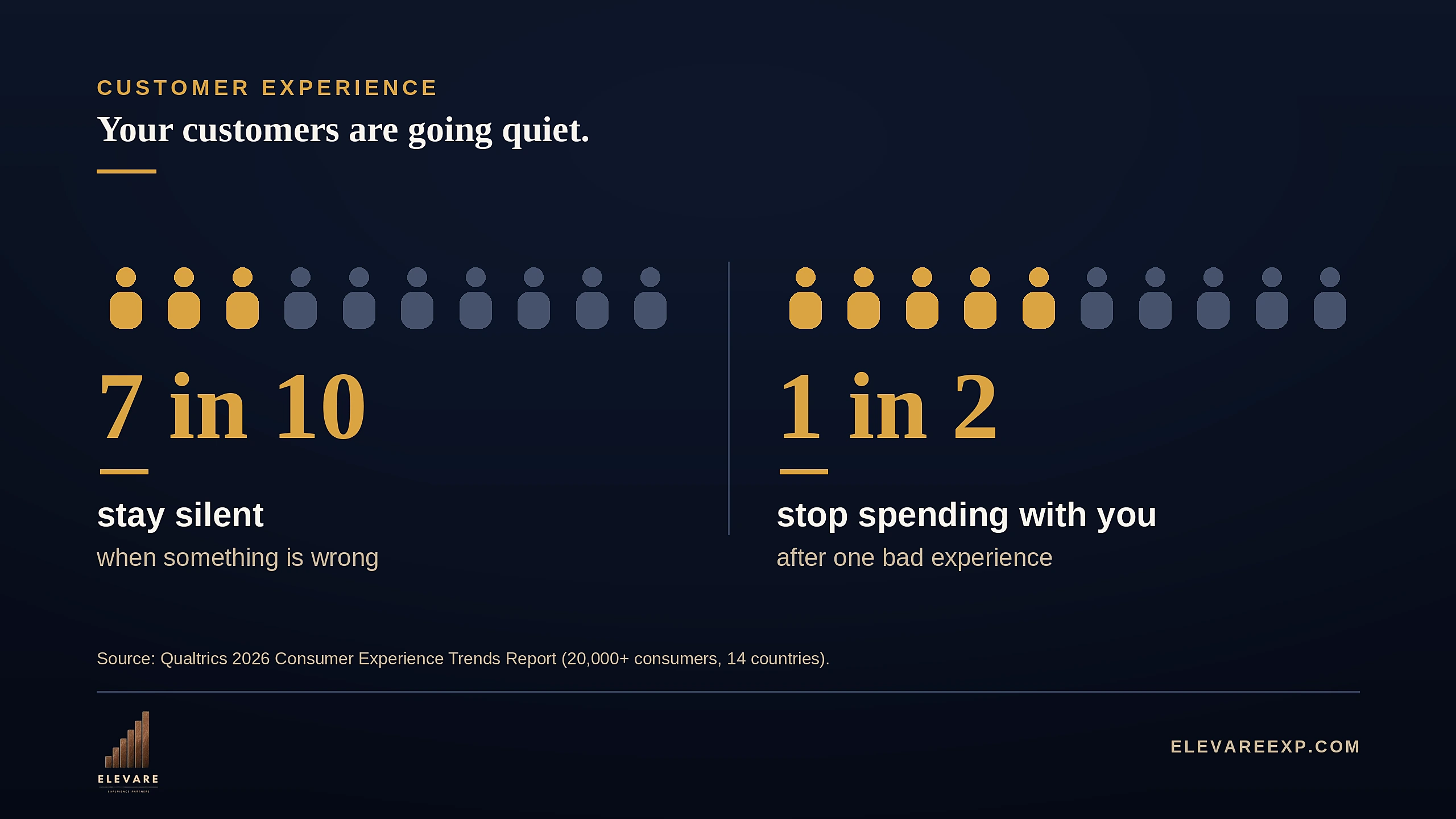
Qualtrics surveyed more than twenty thousand consumers for its 2026 experience report. Two findings sit next to each other and should stop any leader cold. Only about three in ten customers now bother to give direct feedback, a new low. And one in two will cut their spending after a single bad experience. Read those together. Fewer people are telling you when something is wrong, and more of them are punishing you for it without a word.
The popular version of this story is that AI is failing at customer service. That is true, and it is the easy part. Everyone is writing about it. The harder truth underneath is that customers have concluded that telling you is a waste of their time. The survey goes into a void. The chatbot is built to make them go away. The comment card changed nothing last time. So they stop. They do not complain. They do not leave one star. They leave, and they tell you nothing on the way out.
That is a more dangerous place to be than a flood of complaints.
“Complaints are data. Silence is the absence of data dressed up as peace.”
Here is what I tell the executives I work with. If the only way your organization hears from a customer is a channel that customer has already abandoned, you are not listening. You are performing the ritual of listening. Companies built their feedback systems for a world where people filled out surveys, and never built anything for the world where people do not. That is not bad luck. It is a design gap. You went blind in the exact place you most need to see, and you chose it without noticing.
The interesting work now is not another survey with a better subject line. It is building signals out of what customers do, not only what they say. The behavior that goes flat before the contract lapses. The usage that drops before the renewal. The frontline employee who heard the offhand comment no dashboard ever captured. The strongest organizations are turning AI toward this, using it to hear the messy, unstructured signals customers leave everywhere, instead of using it to deflect one more contact. That is the inversion worth making. Stop spending your technology budget making customers easier to ignore. Spend it hearing what they no longer bother to say.
This is the part of experience design that gets skipped, and it is central to how I think about the Human-Intelligent Experience Engine™. Signals are not something you collect once a year. They are something you architect, or you go without.
The quiet in your customer base is not proof that things are fine. It may be the sound of people who gave up on telling you and started spending elsewhere. The organizations that win the next decade will be the ones that got nervous about the silence while everyone else was relieved by it.
If your only early warning system is a survey response rate that keeps falling, we should talk. Reach me at elevareexp.com.
Sources
Qualtrics. “2026 Consumer Experience Trends Report.” 2025. Survey of more than 20,000 consumers across 14 countries.
“Elite organizations don’t separate themselves with strategy. They separate themselves with small behaviors, repeated.”
Organizational PerformanceJune 20265 min read
What Elite Looks Like on a Tuesday
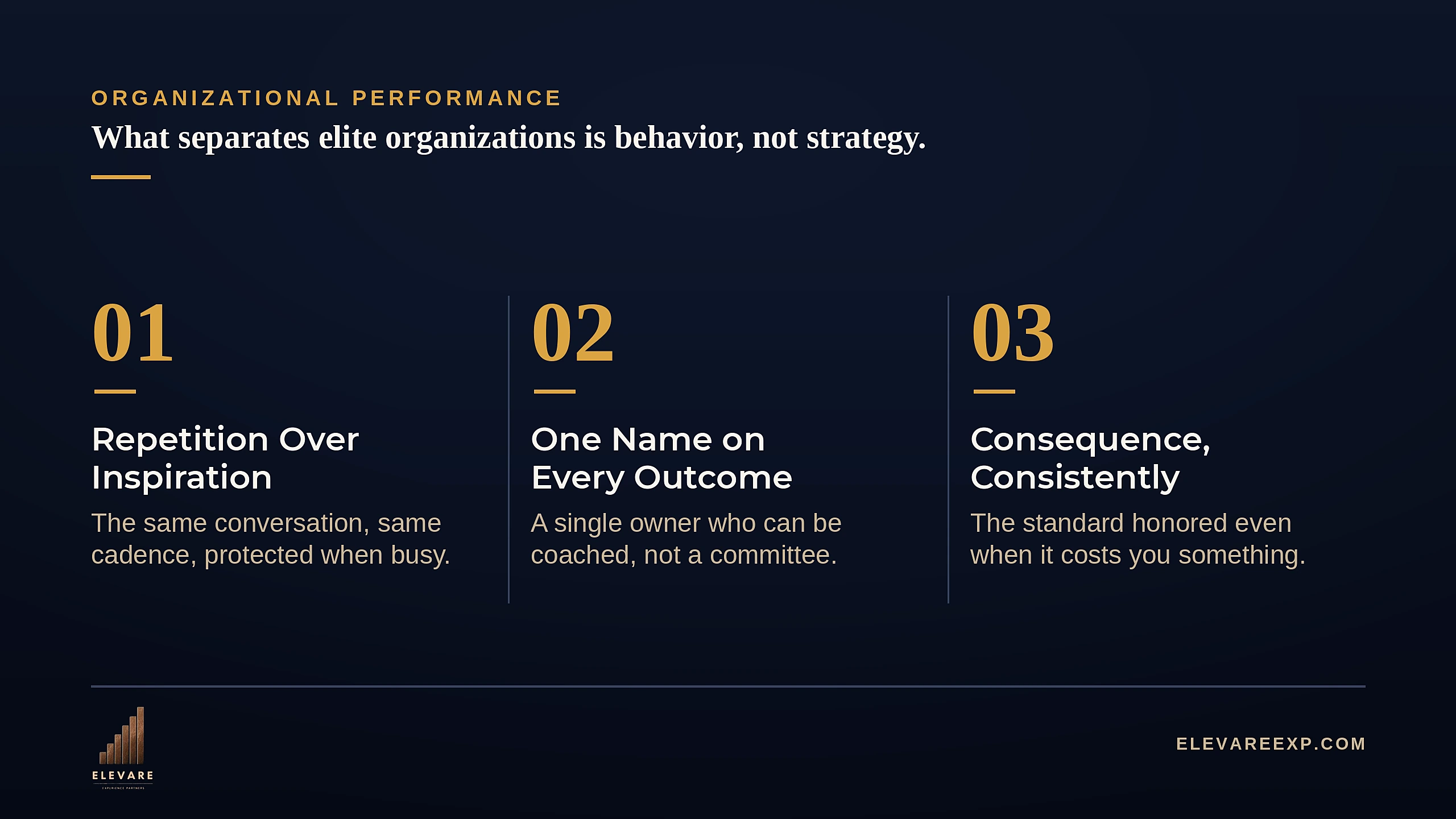
Elite organizations do not separate themselves with better strategy. They separate themselves with a handful of small, repeated behaviors that most companies treat as optional, and they treat as non-negotiable.
Years ago I started paying attention to a small thing. When a team’s regular meeting was scheduled for nine, did it start at nine even when the leader was not in the room. It sounds trivial. It is one of the most reliable tells I know for whether an organization is actually elite or only says it wants to be.
In the last piece I wrote here, I laid out four ways elite organizations differ. They make clarity the default. They catch small problems early. They coach instead of rescue. They treat experience and performance as one system. All four are true, and all four are easy to agree with. What I want to do now is get underneath them, because the difference between elite and average is not just in those four ideas. Almost everyone agrees with the ideas. The difference shows up in a few specific behaviors that produce them, and those behaviors are unglamorous enough that most organizations never bother.
Here are three I have learned to look for.
They Design for Repetition, Not Inspiration
Most organizations are built for the big moment. The annual kickoff. The quarterly all-hands. The offsite with the good catering and the laminated values. Those events are designed to inspire, and for about a week, they do.
Elite organizations invert this. They put almost no faith in the big moment and almost all of it in the small one that repeats. The Ritz-Carlton runs a short daily lineup, the same brief gathering at the start of every shift, in every property, to reconnect the team to the standard before the doors open. It is not a motivational event. It is a cadence. The point is not that any single lineup is profound. The point is that it happens every day, the same way, whether anyone feels like it or not.
That is the behavior. Not the speech, the repetition. A recurring conversation that asks the same few questions, lands at the same time, and does not get cancelled the first week things get busy. Most leaders design for inspiration and forget to design for repetition. Elite organizations do the opposite, and it is the repetition that compounds.
They Put One Name on Every Outcome
Walk into a struggling organization and ask who owns a given result. You will usually get a list. The team owns it. Marketing and sales own it together. It is a shared priority. Shared ownership sounds collaborative. In practice it is the most common place accountability goes to die, because a result that belongs to everyone belongs to no one.
Elite organizations are almost severe about this. Amazon is the clearest public example. In its operating reviews, each metric has a single owner, one name, who is expected to know that number cold and to explain its movement. Not the team. A person. When something drifts, there is no confusion about who is closest to it.
This is not about blame. It is about clarity. A single owner can be supported, coached, and unblocked. A committee cannot. The behavior that separates elite organizations is not that they care more about results. It is that they refuse to let ownership stay vague, because they have learned that vague ownership is just a slow way of deciding no one is responsible.
They Are as Consistent About Consequence as About Recognition
Every organization is happy to celebrate the standard. Recognition is easy and it feels good. The harder, rarer behavior is being just as consistent about what happens when the standard is missed.
This is where most cultures quietly come apart. The values say one thing. The town hall celebrates it. Then a senior performer violates it and nothing happens, because they are too valuable or the moment is too awkward. Everyone watching learns the real standard in that instant, and it is not the one on the wall.
Elite organizations close that gap, and they are willing to let it cost them. Netflix built its talent model on exactly this. Its managers run what the company calls the keeper test: for any given person, would you fight to keep them if they tried to leave? If the answer is no, you act, and you act with a generous severance. Adequate performance, in the company’s own words, earns a generous severance package. That is a hard standard, and the whole point of it is that it applies to good people, not only poor ones. You do not have to adopt the practice to take the principle. The proof that a standard is real is that an organization honors it even when honoring it is uncomfortable.
“People don’t believe what you celebrate. They believe what you’re willing to enforce.”
The Thread Underneath
Notice what these three behaviors have in common. None of them is a strategy. None requires a new framework or a bigger budget. They are small, they are repeatable, and they are mostly about discipline rather than insight.
That is the uncomfortable part. The gap between an elite organization and an average one is rarely a gap in intelligence or intention. It is a gap in what each is willing to do consistently, on an ordinary day, when no one is watching and nothing is on fire. Strategy is what you intend. Culture is what you allow. Rhythm is what you sustain. The three only converge when the daily behaviors are strong enough to hold them together. That is the whole idea behind The Human-Intelligent Experience Engine™. The engine is not the strategy. It is the set of repeated behaviors that decides whether the strategy ever becomes real.
So the question I would leave you with is not whether your organization knows what good looks like. Almost every organization does. It is whether, this Tuesday, the small behaviors that produce it actually happened.
If you want to talk about which of those behaviors your organization has and which it has quietly let slide, reach me at elevareexp.com.
Sources
Colin Bryar and Bill Carr. “Working Backwards: Insights, Stories, and Secrets from Inside Amazon.” St. Martin’s Press, 2021.
Reed Hastings and Erin Meyer. “No Rules Rules: Netflix and the Culture of Reinvention.” Penguin Press, 2020.
Netflix. “Netflix Culture Deck.” 2009.
Horst Schulze. “Excellence Wins: A No-Nonsense Guide to Becoming the Best in a World of Compromise.” Zondervan, 2019.
“The question isn’t whether AI will disrupt you. It’s whether you can see the disruption already underway.”
AI & WorkJune 20267 min read
The Disruption Isn’t Where You’re Looking
I keep hearing from leaders who are bracing for AI to take their people. The real damage is already underway somewhere else, in the rooms they never thought to measure.
The Wrong Fire
I have sat in a lot of leadership conversations over the last year, and the fear in the room tends to sound the same. Some version of: AI is coming for half of these jobs, and we need to get ahead of it before it gets ahead of us.
I understand the instinct. The technology is real, the investment is enormous, and the pace is unlike anything most of us have managed before. The fear is not foolish. But, for now, it is pointed at the wrong place.
Picture a building with a smoke alarm going off in one room. Everyone runs toward the noise. They stand under the alarm, watching it, waiting for flames. Meanwhile the actual fire is two rooms over, quiet, with no alarm wired to it at all. That is roughly where most organizations are with AI right now. They are staring at the alarm. The fire is somewhere they never installed a sensor.
The Number That Refuses to Cooperate
The Conference Board’s Reimagined Workplace 2026 study surveyed 271 human capital leaders and 333 workers at the start of this year. The study is worth reading slowly, because its findings do not match the headlines.
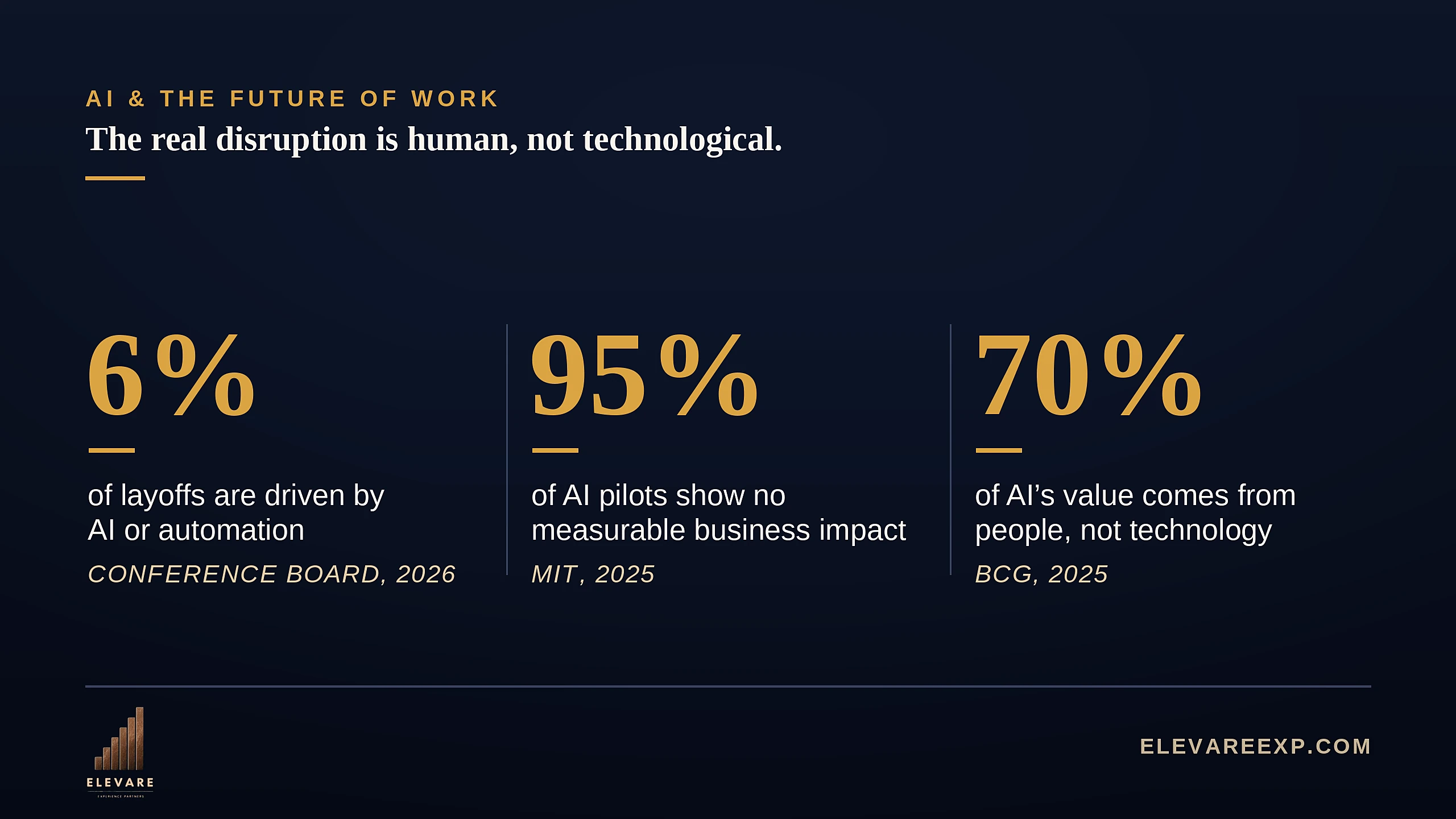
Few organizations are far down the AI road at all. Sixty percent describe their AI maturity as basic awareness or early experimentation. And when leaders who had conducted layoffs were asked why, role elimination from automation or AI was cited by only 6 percent. The layoffs were driven by restructuring and financial pressure, the same forces that have always driven them.
Sit with that for a second. The thing everyone is bracing for is responsible for almost none of what is actually happening.
Even the loudest projections do not say what the panic says they do. The World Economic Forum’s Future of Jobs Report 2025 is the document people quote when they want to sound the alarm. It does project 92 million jobs displaced by 2030. It also projects 170 million created in the same window, a net increase of 78 million. The report most often used to predict collapse actually forecasts growth.
So if AI is not the fire, what is.
Three Gaps Nobody Wired an Alarm To
The damage is real. It is just human, and it is the kind that does not trip an alarm. I see it in three forms.
The first is a readiness gap. The World Economic Forum estimates that if the global workforce were a hundred people, fifty-nine would need reskilling by 2030, and eleven are unlikely to get it. Sixty-three percent of employers already name the skills gap as the single biggest barrier to transformation. The threat is not that the machine arrives. It is that the training never does.
The second is a perception gap. McKinsey’s Superagency in the Workplace found that leaders estimate only 4 percent of employees use generative AI for a meaningful share of their daily work. Employees themselves report a number three times higher. The Conference Board found the same shape of blindness in a different place: leaders rate their employees lower than workers rate themselves on every single dimension of employee experience measured. Two separate studies, one conclusion. Leaders are not seeing their own people clearly.
The third is a measurement gap, and it is the most dangerous because it hides the other two. The Conference Board found that the experience dimensions with the widest perception gaps, well-being and mental health, are exactly the ones leaders admit are hardest to assess. Nearly half say mental health is difficult to read at all. And the instrument most leaders rely on to read the floor, the manager, is failing at the same time. Gallup’s latest global study found employee engagement fell to 20 percent in 2025, its lowest level in five years, and that manager engagement dropped from 27 percent to 22 percent in a single year.
AI did not create these gaps. It is pulling them into the daylight.
I Watched This Long Before It Had a Name
None of this is new to me. It only has new vocabulary.
I spent close to four decades inside real commercial environments before I started Elevare. Collections at Ford Credit, starting in 1985, where the phones never stopped and the margin for error was zero. Conference rooms at DaimlerChrysler. The Cerberus years at Chrysler Financial. Then TD Auto Finance, where a team was told to assimilate or leave, and I tried to hold it together anyway. A startup build at Automotive Capital Services, inventing the playbook in real time. And finally Disney Institute, where I will say it plainly: that experience did not teach me how to build great organizations. The work itself did, drawn from many businesses and experiences including Disney. What Disney gave me was the language to name what I had already built.
I lived through nearly every change a balance sheet can produce. A merger, a demerger, a private equity sale, a corporate bankruptcy, an acquisition by a bank. And the same thing happened every time. The legal change landed first, on paper, in a press release. The operational change, the part that actually touched people, came months or years later, if it came at all. The org chart moved at the speed of lawyers. The culture moved at the speed of trust.
“The org chart moved at the speed of lawyers. The culture moved at the speed of trust.”
And the pattern never changed. The organizations that thrived were not the ones with the most talented people. They were the ones where talented people knew what was expected, had what they needed, and were led by someone who showed up the same way twice. The ones that struggled were not short on talent. They were short on design. Now we are about to run that same test again, at a higher voltage, with AI as the current. The result will be decided by the wiring, not the current.
A Mirror, Not a Meteor
This is the part most leaders have backward. They are treating AI like a meteor, an external force about to hit them from the outside. It is more like a mirror. It reflects what was already there.
The evidence is hard to argue with. MIT’s State of AI in Business 2025 studied enterprise AI against tens of billions in spending and found that 95 percent of pilots delivered no measurable impact on the bottom line. Only 5 percent created real value. The researchers were explicit about the cause. It was not the quality of the models. It was a learning and integration gap inside the organizations themselves.
BCG arrives at the same place from a different road. Its work puts only 10 percent of the value of AI in the algorithms and 20 percent in the technology and data. The other 70 percent comes from people, process, and culture. In BCG’s global study, roughly 5 percent of organizations captured substantial financial gains from AI, and that group posted three-year shareholder returns about four times higher than the rest.
Notice that both studies, run independently, landed on the same 5 percent. That is not a coincidence. That is what it looks like when the deciding factor is not the technology.
An organization that was clear, aligned, and honest about how it treats its people will hand AI a strong foundation to amplify. An organization with a culture running by default, where purpose says one thing and incentives reward another, will hand AI its dysfunction to amplify instead. The mirror does not flatter. It magnifies.
What the Engine Does With This
I founded Elevare Experience Partners to work on exactly this layer. The framework I use, The Human-Intelligent Experience Engine™, treats culture, experience, and results as one system rather than three separate conversations. That matters here because the three gaps are not three problems. They are one problem showing up in three places, and they have to be diagnosed together.
The Engine reads the signals the surveys miss. It looks at attrition by segment, at overtime, at the gap between what leaders believe their culture is producing and what it is actually producing. It does not replace the framework a company already has. It builds on it, and closes the distance between measurement and action.
It is worth noting that the market’s most credible independent voice has arrived at the same conclusion. Josh Bersin’s recent research on the AI era argues that transformation is a people challenge, not a technology one, and that companies using AI only to cut payroll will be beaten by those that use it to elevate their people. I didn’t need his research to reach that view. I reached it on the floor at Ford Credit, back when the only intelligence in the building was human. But it is useful to know the serious analysts are now standing in the same place.
The Philosophy Has to Keep Expanding
I will be honest about one thing. The specific numbers in this article will age. The tools will change again, and then change again after that. Today it is generative AI. In three years it will be something with a different name.
The premise underneath does not move. Culture multiplies whatever you put through it. That was true of the assembly line, true of the internet, and it will be true of whatever follows AI. The data dates. The diagnostic does not. An Engine built on how humans actually create and experience value will keep working long after this particular wave of technology is old news.
Find Your Side Door
The question is not whether AI will disrupt you. It will. The question is whether you can see the disruption already happening inside your own building, in the rooms where you never installed an alarm.
If your people are quietly disengaging, if your managers are running on empty, if your leaders cannot honestly tell you how their teams are doing, that is the fire. AI will only make it burn faster.
Find your side door before the smoke reaches it. If you want to talk about where yours is, that is the work we do. Reach me at elevareexp.com.
Sources
The Conference Board. “The Reimagined Workplace 2026: Adopting AI Today, Poised for Tomorrow.” March 2026. conference-board.org
World Economic Forum. “Future of Jobs Report 2025.” January 2025. weforum.org
McKinsey & Company. “Superagency in the Workplace: Empowering People to Unlock AI’s Full Potential.” January 2025. mckinsey.com
MIT (Project NANDA, MIT Media Lab). “The GenAI Divide: State of AI in Business 2025.” 2025.
Boston Consulting Group. “AI Transformation Is a Workforce Transformation,” and the BCG 10-20-70 principle. 2024–2026. bcg.com
Gallup. “State of the Global Workplace 2026.” gallup.com
The Josh Bersin Company. “The Rise of the Superworker: HR and Leadership Predictions and Imperatives for 2025.” January 2025. joshbersin.com
“You don’t need a castle logo to design a culture that works. The principles are portable. The architecture is learnable.”
Customer ExperienceApril 20267 min read
What Disney Taught Me About the Architecture of Experience
The world’s most admired experiences don’t happen by accident. They are engineered intentionally, delivered consistently, and improved relentlessly. After thirty years of pattern-matching across industries, Disney gave me the language to name what I’d already lived.
The Classroom I Didn’t Know I Was In
The most admired experiences in the world don’t happen by accident. They happen by design. Walk into a Ritz-Carlton property, check in at a great financial advisor’s office, or sit down with a team that actually functions, and you feel something specific. You can’t always name it. But you know it the moment it’s there, and you feel its absence the moment it’s not.
I spent more than thirty years watching that feeling get created, and destroyed. In collections with Ford Credit where the phone volume was relentless and the margin for error was zero. In conference rooms at Chrysler where executives in the same meetings would speak in their native tongues to make sure their colleagues from the other side of the company would not understand. In startup mode at Automotive Capital Services (ACS), where we were inventing the playbook in real time. In executive discussions at TD Auto Finance, trying to hold together a team that were given the choice to assimilate or leave.
I had a front-row seat to what works. I watched leaders who created followership and leaders who created compliance, and learned they are not the same thing. I watched teams that delivered because they were clear and capable, and teams that underperformed because no one had ever told them what winning looked like. I saw customer experience built from the inside out, and I saw it collapse the same way.
What I didn’t have, for most of those thirty years, was a clean vocabulary for what I was seeing. I had the pattern. I didn’t have the language. That changed when I joined Disney Institute.
What Disney Gave Me, And What It Didn’t
In October 2018, I joined Disney Institute as a senior sales leader. Disney Institute was the professional development and advisory arm of The Walt Disney Company, the organization tasked with helping other companies understand and apply the principles behind Disney’s world-class guest experience. We worked with hospitals, financial institutions, manufacturers, retailers, and global sporting events. The mission was clear: translate what Disney does into something portable and actionable for organizations without a castle or a mouse known worldwide.
I want to be precise about something, because it matters for everything that follows: Disney did not teach me how to build great experiences. Thirty years in corporate America taught me that. What Disney gave me was the framework and the language to articulate what I already knew.
That is not a small thing. Naming a pattern is how you replicate it. Before Disney Institute, I had been doing what many experienced leaders do, operating on hard-won intuition, recognizing dysfunction without being able to diagnose it, building culture more by feel than by design. Disney handed me a precision instrument. I arrived expecting to sell. I discovered I was being given a vocabulary for things I had already lived.
“You don’t need a castle or a mouse known worldwide to design a culture that works. The principles are portable. The architecture is learnable. And the results are measurable.”
Experience Is Architecture, Not Attitude
Here is the single most important thing I took from my time at Disney Institute, and the insight that reframed everything I had observed in thirty years of corporate life: experience is not something your team delivers by trying harder. It is something your organization designs, or fails to design.
Disney’s operational framework for guest experience isn’t a values statement. It’s a system. The Five Keys, Safety, Courtesy, Inclusion, Show, and Efficiency, are a prioritized decision-making hierarchy baked into every role, every training program, every physical environment, and every performance conversation. A cast member at the Magic Kingdom isn’t smiling because Disney hired cheerful people. They’re smiling because Disney built systems that make it operationally easy to smile: clear expectations, consistent training, clean sightlines (literally and figuratively), leaders who model the behavior, and feedback loops that reinforce what right looks like.
That is not magic. That is architecture.
When I looked at that framework through the lens of thirty years in financial services and startups, I recognized it immediately. The organizations I had seen thrive were not the ones with the most talented people. They were the ones where talented people knew exactly what they were supposed to do, had the tools to do it, and were led by people who showed up consistently and rewarded the right behaviors. The organizations I had seen fail were not short on talent. They were short on design.
The smiles at Disney are the output. The system underneath is the input. Organizations that try to copy the smiles without building the system are doing what I’d call cosmetic CX, and it doesn’t hold.
The Same Engine, Running for Thirty Years
One of the most clarifying concepts I encountered at Disney Institute was the Zone of Exceptional Service. It isn’t a slogan. It’s a model: the Zone lives at the intersection of people, process, and place. Think of it as a Venn diagram where each circle represents one of those three dimensions. When all three are working, the Zone is at its strongest. When one of them is missing or misaligned, the Zone shrinks, and the customer feels the difference whether they can name it or not.
That model resonated with me not because it was new, but because it named something I had been watching for three decades. The organizations that consistently created great experiences didn’t get there by hoping their people were having a good day. They designed the right conditions. Their people were clear and capable. Their processes removed friction instead of creating it. And their physical or operational environment sent the right signals at every turn. All three circles were drawn with intention.
I had seen the same pattern run in both directions. At Ford Credit, the national accounts team generated significant volume not because we had the lowest rate, but because the relationship, the process, and the way we showed up were all aligned. The customer trusted the Zone we had built, even without a name for it. At TD Auto Finance, the challenge after the acquisition wasn’t the product. It was that one of the three circles had been pulled out from under the team. The people were still there. But the process had changed and the environment was uncertain. The Zone collapsed, and performance followed.
At ACS, we were building all three from scratch simultaneously. No inherited process. No established environment. A team we were assembling in real time. What I understand now is that we were trying to draw the Zone without a compass. We got some of it right. We got some of it wrong in ways I can now diagnose precisely. Disney gave me the language and the lens I didn’t have then.
4–8%
Revenue growth above market for CX-leading companies (Bain & Company)
41%
Faster revenue growth at customer-obsessed organizations vs. peers (Forrester 2024)
52%
Of consumers stopped buying after a bad experience (PwC 2025)
Introducing the Experience Engine
The framework I use today, what I call the Human-Intelligent Experience Engine, emerged directly from this convergence of thirty years of pattern recognition and the time I spent inside Disney Institute. It is not a Disney framework. It is mine. But Disney was the crystallization point where the patterns I had been accumulating for decades finally locked into a coherent structure I could name, teach, and replicate.
The Experience Engine is built around a set of interconnected elements spanning leadership, people, process, and experience design. I won’t detail every component here, as the full framework is the subject of a book I’m completing this summer. But at its core, the Engine provides a diagnostic and design tool that allows me to define what exceptional experience looks like when it works, and to identify exactly what is breaking down when it doesn’t.
More importantly, it is a transformation framework. It gives leaders a structured way to close the gap between the culture they intend and the one they have actually built, to elevate the experience their customers and employees actually receive, and to connect those improvements to outcomes that show up on a balance sheet. Culture, experience, and results are not three separate conversations. The Experience Engine treats them as one.
Dennis Snow, 20-year Disney World veteran, on the CX lessons that translate to any industry.
The Principles Are Portable
Here is what I hear most often from executives when the Disney comparison comes up: “That’s great for them. They have a theme park. We’re in financial services / healthcare / manufacturing / logistics. It doesn’t translate.”
I understand the instinct. Disney is a singular brand in a singular category. But the objection misidentifies what made Disney’s experience framework successful. It was not the Magic Kingdom. It was the operating system underneath it. And operating systems are industry-agnostic.
Every organization has a purpose, stated or unstated. Every organization has a strategy, deliberate or accidental. Every organization has a culture, designed or inherited. Every organization has leaders who either amplify or undermine the experience they claim to want. Every organization has frontline employees who are either clear and capable or uncertain and underserved. Every organization has customers who are either building loyalty or quietly looking for a better option.
The question is never whether you have an Experience Engine. The question is whether yours is designed and aligned, or whether it is running on defaults that no one chose and no one is managing.
Disney is one data point in my thirty-plus years of evidence. It is a vivid one, a highly engineered, highly studied, highly visible proof of concept. But the same engine ran at every high-performing organization I was ever part of, and broke down the same way in every low-performing one. That pattern doesn’t require a castle. It requires intention, alignment, and the willingness to design what most organizations leave to chance.
What This Means for You
I founded Elevare Experience Partners to do exactly this work, to help organizations audit, design, and operate their Experience Engine. Not as a Disney lookalike exercise. Not with a framework borrowed from a theme park and rebranded for corporate use. But with a rigorous, adaptive methodology built from three decades of real commercial environments: automotive finance, banking, private equity-backed startups, and yes, one of the most experience-sophisticated organizations in the world.
The leaders I work with are not struggling because their people are bad or their products are weak. They are struggling because the engine is misaligned, because purpose says one thing and incentives reward another, because leaders talk about empowerment but approve every decision, because the frontline is expected to deliver an experience the systems were never designed to support.
The fix is not a training program. It is not a new values statement. It is not a Disney study tour. It is architecture. Intentional, connected, measurable architecture. That is what the Experience Engine is built to diagnose and deliver.
If your organization’s experience, customer or employee, is not producing the outcomes you need, the answer is almost always upstream. The place to start is not the touchpoint. It is the foundation.
That is what Disney taught me. And it is what thirty years before Disney confirmed.
Sources
Forrester Research. “Forrester’s 2024 US Customer Experience Index.” June 2024. forrester.com
Bain & Company. “The Five Disciplines of Customer Experience Leaders.” 2015. bain.com
Dennis Snow. “4 Customer Experience Lessons I Learned at Disney That Work Anywhere.” youtube.com
“The fundamentals of people management, communication, and trust-building have not changed because AI arrived.”
AI & WorkApril 20268 min read
The Fundamentals Don’t Change at 30,000 Feet
AI is reshaping organizations at a pace that outstrips most leaders’ ability to manage the transition. The real disruption isn’t technological. It’s cultural. And the organizations that will come through it strongest are the ones that already know how to keep their people informed, aligned, and trusted.
You’re Already Flying
Imagine you’re a passenger on a long flight. Somewhere over the Atlantic, something goes wrong with the plane. The crew gets to work. Systems are being repaired mid-flight, decisions are being made in real time, and the technology being used to fix the problem—AI-assisted diagnostics, automated alerts, tools the crew has been trained on but never fully stress-tested at altitude—is still being calibrated as the aircraft stays aloft.
Now imagine the flight crew is also trying to communicate with 200 passengers, many of whom can sense something is off, but aren’t sure what, how serious, or how long it will last. The crew must project calm and confidence while solving a problem they have never solved before at this altitude, at this speed, with this much at stake.
This is precisely where most organizations find themselves right now.
The disruption is real. The urgency is real. But the most dangerous assumption any leader can make in this moment is that the problem is primarily technical.
It isn’t.
The Smart-Healthy Gap
In his landmark book The Advantage, Patrick Lencioni draws a distinction that cuts right to the heart of why so many organizations underperform despite good strategy, capable people, and adequate resources. He argues that most companies are reasonably smart, proficient in strategy, marketing, technology, and finance, but far fewer are genuinely healthy.
A smart company knows what to do. A healthy company is actually able to do it, consistently and sustainably, because its people trust each other, its leadership communicates with clarity, and its culture reinforces what matters most.
“The seminal difference between successful companies and mediocre or unsuccessful ones has little, if anything, to do with what they know or how smart they are. It has everything to do with how healthy they are.”
The data supports him. According to a global study by the Institute for Corporate Productivity (i4cp, 2023), organizations reporting top cultural health outperform their peers in market performance 6 times more often than those with unfit cultures. Aon’s Engagement 2.0 Study found companies with high cultural alignment generate 4.4x higher revenue and 4x higher EBITDA than their peers. Eagle Hill Consulting found that 77% of employees say culture directly affects how well they do their best work, and 74% say it shapes their ability to serve customers.
Culture is not a soft concept. It is a financial multiplier.
6xMore likely to outperform peers with top cultural health
4.4xHigher revenue with high cultural alignment (Aon)
62%Higher employee tenure in healthy performance cultures
The Elevare Premise: Culture Multiplies Everything
At Elevare Experience Partners, our foundational belief is that culture multiplies the benefits of business practices. You can implement the smartest strategy, deploy the most sophisticated technology, and hire the most talented people. Culture will determine whether any of it compounds into real organizational performance.
This is not inspirational framing. It is operational truth.
The companies getting the most from their people, their processes, and their technologies are the ones that have been intentional about culture, not as a banner on the wall or a values statement in the employee handbook, but as a set of principles and practices that are deliberately created, implemented, and managed. As O.C. Tanner’s 2026 Global Culture Report found, organizations with what they call “healthy performance cultures,” defined by both high expectations and high support, see 62% higher employee tenure, 58% fewer employees seeking to leave, and a 38% reduction in burnout.
Culture is not accidental. The best cultures are designed.
That means leaders can be intentional about building them. Maintaining them. Strengthening them, especially when conditions get turbulent.
The Real Disruption Is Happening Inside the Organization
There is an enormous amount of noise right now about artificial intelligence and its implications for the workforce. The anxiety is legitimate. According to a 2025 Resume-Now survey, 89% of U.S. workers express concern about AI’s impact on their job security. A Jobs for the Future survey conducted in late 2025 found that 44% of respondents now believe AI is doing more harm than good, a reversal from just a year earlier.
What makes this moment genuinely hard is that leaders are absorbing pressure from every direction simultaneously. Boards want faster adoption. Employees want reassurance. Competitors are moving. And the tools themselves keep changing. That is not a failure of will. It is the reality of operating in a period of compressing timelines and expanding expectations.
But the data also points to something worth examining closely: much of the disruption employees are feeling is not coming from AI itself. It is coming from the gap between how fast change is being rolled out and how well organizations are bringing people along.
Only 36% of workers say they have the training and resources needed to use AI on the job, a drop of nearly ten percentage points in a single year (Jobs for the Future, 2026). A full 56% say their employers have not consulted them about how AI tools are being used in their work. Per McKinsey’s 2025 AI in the Workplace report, there is a significant gap between what leaders believe their employees think about AI and what employees actually think. Leaders consistently underestimate both how much employees are already using AI and how significantly they expect it to reshape their roles.
This is where the culture and communication dimensions of transformation become decisive. Not a technology problem, but a people and organizational one.
BCG put a number on it: AI transformation is 70% people, process, and organization, and only 30% technology. Yet most organizations invert that ratio in how they allocate budget and attention. The result is what McKinsey has confirmed: approximately 70% of transformation programs fail to achieve their stated objectives. The failure modes are overwhelmingly human—employee resistance, poor communication, insufficient executive sponsorship, and inadequate capability building.
“The passengers can feel the turbulence. The crew is focused on the instruments. Nobody is having the conversation that actually needs to happen.”
The Flight Crew Principle
Here is the honest reality: most leadership teams are managing AI transformation without a clear map, because no map exists yet. Technology whose upper and lower limits are not yet fully known is being deployed across industries in real time, with real consequences. It is, quite literally, fixing the plane while flying.
What separates great pilots from anxious ones in genuine turbulence is not superior knowledge of the weather ahead. They don’t abandon the fundamentals of flight. They trust them more.
Aerodynamics don’t change because the weather is severe. Cockpit protocols don’t change because the situation is unfamiliar. And the obligation to communicate clearly, calmly, and honestly with passengers doesn’t change because the crew is under stress.
The same principle applies to organizational leadership.
The fundamentals of people management, communication, and trust-building have not changed because AI arrived. If anything, they matter more. Employees who feel secure in their roles are far more likely to embrace AI. The Edelman Trust Barometer Flash Poll on AI (2025) found that employees who believe AI will enhance their productivity rather than eliminate their positions are dramatically more enthusiastic adopters. Trust enables growth. Culture creates trust.
Ron Kaufman on the difference between leaders who talk about culture and those who actually change it — a distinction that matters most when the stakes are highest.
The Principles Behind Intentional Leadership
Lencioni identified four disciplines that characterize healthy organizations. None of them are new. None of them require an AI prompt or a machine learning model. What they require is consistent, disciplined leadership, and that consistency is precisely what becomes most difficult to maintain when an organization is under transformation pressure.
Understanding these disciplines matters because they represent the intellectual foundation of what high-performing organizations have always done in periods of significant change. The challenge in the current AI environment is not identifying the principles. Most experienced leaders already recognize them. The challenge is applying them with the speed, specificity, and organizational reach that this moment demands, while the plane is already in the air.
Building cohesive leadership alignment, creating and sustaining clarity for employees, communicating that clarity consistently across every level of the organization, and reinforcing it through the structures and systems that shape daily behavior: these are not new ideas. They are enduring ones. And the distance between knowing them and executing them well, at scale, under pressure, is exactly where organizations most often lose altitude.
That gap between principle and practice—in real conditions, with real teams, at the pace this moment demands—is exactly where Elevare works.
Not Just Smart. Healthy.
The organizations that will win the next decade will not be the ones with the most sophisticated AI tools. They will be the ones with the cultural fitness to deploy those tools in ways that actually serve their people, their customers, and their mission.
That distinction, smart versus healthy, will be the defining competitive advantage of this era.
At Elevare, we believe the work of helping leaders through this moment is not about becoming AI experts. It is about becoming better leaders: clearer communicators, more intentional culture builders, more confident guides through change. We help organizations find the balance between the pace of transformation and the fundamentals that never change, no matter how high the altitude.
The goal is not just to land the plane. The goal is for everyone on board to arrive with their confidence in the crew, and in each other, intact.
That is what makes a healthy organization. And that is exactly the kind of organization worth building.
Sources
Lencioni, Patrick. The Advantage: Why Organizational Health Trumps Everything Else in Business. Jossey-Bass, 2012.
“High performance isn’t a character trait. It’s a habit. And habits don’t build themselves.”
Organizational PerformanceApril 20265 min read
The Operating Rhythm: Building the Habit of High Performance
Elite organizations don’t rely on motivation or heroics. They build operating rhythms that quietly make high performance the path of least resistance.
Let me ask you something direct. When was the last time your organization’s results genuinely surprised you—and not in a good way?
If you’ve been there, you probably don’t have a talent problem. You have a rhythm problem.
I’ve spent thirty years watching cultures produce results no one intended—in finance companies, dealerships, startups, and inside one of the most studied customer experience organizations in the world. The lesson was always the same. Elite organizations don’t outperform because they hire better people or write better vision statements. They outperform because they build operating rhythms that quietly make high performance the path of least resistance.
What Rhythm Actually Means
An operating rhythm isn’t a meeting schedule. It’s the repeating cadence through which your organization thinks, decides, and learns together—the architecture that keeps strategy from being something you revisit twice a year and forget in between.
When it works, a rhythm does something that motivation and talent alone can’t: it makes the right behavior easier than the wrong one. It creates the conditions where people know what matters, feel supported to act on it, and can see clearly when things are drifting off course.
When it doesn’t work, the organization runs on heroics. A small number of people hold things together through effort and force of will, while the system itself does nothing to help them. That’s not a culture strategy. It’s a retention risk.
What I Kept Seeing
Early in my career, I thought culture was what leaders said in town halls. After a while, I realized culture was something quieter—and more powerful. It was in the corrections someone made, or didn’t make, before they handed work up the chain. It was in the pace a leader set when things got hard. It was in what got talked about first, and what got quietly skipped.
I saw this pattern in organizations of every size and type. In some, the rhythm was so strong that when a genuine crisis hit, people knew exactly what to do—because the system had already built the habits, the trust, and the clarity they needed. In others, even small disruptions became crises, because no one had ever built a reliable cadence for thinking and deciding together.
The difference wasn’t brilliance or motivation. It was design.
What High‑Performing Rhythms Do
Organizations that get this right consistently do a few things differently:
They make clarity the default, not the exception. Every recurring conversation answers the same few questions: What matters right now? Who owns it? What will we stop to make room for it?
They surface issues while they’re still small. The rhythm is designed to catch weak signals—from employees, from customers, from the work itself—before they become crises.
They shift leaders from rescuing to coaching. Instead of jumping into the work, leaders use these touchpoints to unblock, support, and ask better questions.
They treat experience and performance as one system. Customer and employee signals sit alongside financial and operational results—not in a separate “culture conversation” held once a year at the offsite.
None of this is complicated. All of it is intentional.
The Gap Most Organizations Don’t See
The most dangerous gap I’ve encountered isn’t between strategy and execution. It’s between what leaders believe their culture is producing and what it’s actually producing.
Culture doesn’t announce itself. It accumulates quietly in the daily rhythms of decisions, conversations, and trade‑offs—until one day it shows up on a report, in a resignation, or in a customer satisfaction score that nobody saw coming.
The operating rhythm is the mechanism that keeps you honest about that gap. But only if it’s designed to. Only if leaders are willing to use it for more than status updates.
The organizations that have impressed me most—in industries ranging from automotive to hospitality to financial services—weren’t remarkable because their people were exceptional. They were remarkable because the system made it easier to do the right thing than the wrong one. And they built that system on purpose, not by accident.
Your Next Move
If your organization relies on its best people pushing the boulder uphill every quarter, it’s worth asking a harder question: is the boulder the problem, or is it the hill?
High performance isn’t a character trait. It’s a habit. And habits don’t build themselves.
If you’d like to explore what a Human‑Intelligent operating rhythm could look like for your team, I’d welcome the conversation. Send me a note or visit elevareexp.com to learn more about the Experience Engine and how we help leaders close the gap between the culture they intend and the one they’ve actually built.
“Culture is not what you declare. It’s what you tolerate and what you celebrate.”
Culture & LeadershipMarch 20265 min read
Why Culture Initiatives Fail—and What Elite Organizations Do Differently
Most “culture initiatives” are just expensive theater: lots of posters, very little progress. Elite culture initiatives succeed because leaders redesign how work is done, supported, and felt every day.
Why most culture initiatives fail
Most culture programs die in three familiar ways. They are framed as a campaign, not a system: posters, videos, and town halls with no change in decisions, staffing, or measures. They sit “next to” the business instead of inside it, so leaders talk about culture while still rewarding only short‑term volume and cost. They are under‑invested in managers, who end up translating big words into inconsistent local realities, creating cynicism and fatigue.
The pattern is simple: if “culture” does not show up in how people are selected, trained, coached, resourced, and recognized, it becomes background noise.
What elite organizations do differently
Organizations that actually move the needle on experience start with a different assumption: culture is an operating system, not an HR project. They define a small set of non‑negotiable behaviors that connect directly to customer promises and business outcomes. They build those behaviors into hiring profiles, training curricula, coaching routines, and metrics. They invest in leaders as the primary “user interface” of the culture, not as an audience for slide decks. Using only publicly available sources, I located three organizations that illustrate that doing it right is simple, but not easy.
Humana, Porsche, and BioLife each offer a public glimpse of what this looks like when it is done intentionally and over time.
Humana: service as a supported habit
Humana’s public materials emphasize professional development, structured learning, and programs that support the skills, knowledge, and well‑being of their workforce. Their philosophy is explicit: investing in employees is how they improve the quality of care for members and patients, not an optional perk.
Porsche: engineering the service experience
Porsche’s recent results in the J.D. Power Customer Service Index tell a story of deliberate focus. The brand now leads the industry in dealership service satisfaction—treating “Porsche‑level” service as something you design, train for, and measure.
BioLife: people as the primary delivery system
BioLife combines clear expectations for experience, investment in front‑line capability, and intentional leadership pipelines—turning culture into an asset the customer can feel.
Your next move
If you suspect your own culture initiatives fall into the “campaign” trap, I’d love to explore that with you. Send me a note or comment “Culture” on LinkedIn and we can set up time for a short diagnostic we use to pinpoint where your experience architecture is helping—and where it is quietly holding you back.
“Every day, leaders set the temperature. The only variable is whether they are doing it on purpose.”
Culture & LeadershipMay 20266 min read
Setting the Temperature: How Leaders Shape Culture Without a Memo
The Memo Nobody Reads
There is a thermostat in every organization. Most leaders never find it. Almost none realize they are it.
Culture change does not start with a vision document. It does not arrive on a Tuesday afternoon when the new values deck drops in the all-staff meeting. It starts in the hallway. The offhand comment after a tough quarter. The reaction when something goes sideways. The question a leader asks, or conspicuously does not ask.
Every day, leaders set the temperature. The only variable is whether they are doing it on purpose.
Culture decks are aspirational fiction until behavior makes them real. You can laminate your values, hang them in the lobby, and print them on coffee mugs. If the senior VP rolls their eyes in a one-on-one, employees read that, not the poster.
People inside organizations are extraordinary observers. They are, in fact, professionally and continuously in the business of reading the room. They watch what leaders celebrate. They watch what leaders tolerate. They notice who gets promoted after a colossal failure versus who gets quietly reassigned. All of that is data, and all of it is setting the temperature whether you intend it or not.
“Culture decks are aspirational fiction until behavior makes them real. People do not follow the vision statement. They follow the leader’s behavior when no one important is watching — except everyone always is.”
The Moments That Actually Matter
Culture lives in micro-moments. The ones that feel too small to manage and too quick to catch. How a leader responds when their key subordinate says or does something completely counter to the cultural norms they have expressed to the rest of the team. Whether curiosity or defensiveness shows up in a debrief. Whether “we need to talk” gets scheduled at 4:55 on a Friday.
These are not random. They are a pattern. And patterns, repeated often enough, become culture.
The most effective leaders understand something counterintuitive: you cannot communicate your way into a culture you do not model. No amount of inspiring all-hands messaging closes the gap between what is said and what is lived. People do not follow the vision statement. They follow the leader’s behavior when no one important is watching, except everyone always is.
Intentional Temperature-Setting
Deliberate looks like the leader who pauses before reacting to bad news, because they know the room is tracking how failure gets treated. The one who asks “what did we learn?” instead of “who missed this?” The executive who visibly champions the quiet contributor before the loud result.
None of this is soft. It is some of the hardest, highest-leverage work in leadership, because it requires conscious choices in the moments that feel the smallest.
70%Of the variance in team engagement is attributable to the manager (Gallup)
3.7xHigher likelihood of strong financial performance for companies with healthy cultures (McKinsey)
82%Of employees say leader behavior matters more than stated values (Gartner)
Here is the insight most organizations miss: culture is not a communications problem. It is an alignment problem. The gap is not between what leaders say and what employees hear. It is between what leaders intend and what they actually do in the moments that count. Closing that gap is the whole game.
Simon Sinek on why strong cultures are built deliberately — through the small, repeated behaviors leaders choose to model rather than the values they choose to declare.
Your Thermostat Is Already Running
The temperature is being set right now, in your building, your calls, your inbox response time, your reaction to the last piece of unexpected news. The only question is whether you are setting it with intention.
The good news is that thermostats can be adjusted. But only once you know where to find yours.
At Elevare, we help leaders identify the moments already shaping their culture and align them with the experience they actually want to deliver. That is not a memo. That is the work.